If you are a solo builder — designer, engineer, agency of one, indie SaaS founder, consultant — it is tempting to keep everything in your personal name. Your personal email signs the contract. Your personal account receives the invoice. Your personal wallet holds the treasury.
That feels efficient. Until something goes wrong.
An LLC — a Limited Liability Company — is the legal wrapper that turns “you, personally” into “a company that can sign, bank, invoice, and absorb risk.” You do not need a co-founder, a raise, or a ten-person team to justify one. Solo is enough. Solo is often the reason.
At OtoCo, we form companies for builders who want infrastructure without the law-firm ritual. We pioneered instant onchain LLCs because starting a serious company should feel closer to deploying software than decoding paperwork reserved for the ultra-wealthy.
This guide is for solopreneurs and small builders — not only crypto founders. Here is why every builder needs an LLC, even when the headcount is one.
Short answer: An LLC separates your personal assets from business obligations, lets you invoice and bank in the company’s name, unlocks an EIN (the company’s tax ID), and creates a cleaner tax and bookkeeping story. Operating forever in your personal name is the expensive shortcut.
The risk of your personal name on contracts
When you sign a client agreement as yourself, you are not “keeping it simple.” You are putting your personal balance sheet behind the work.
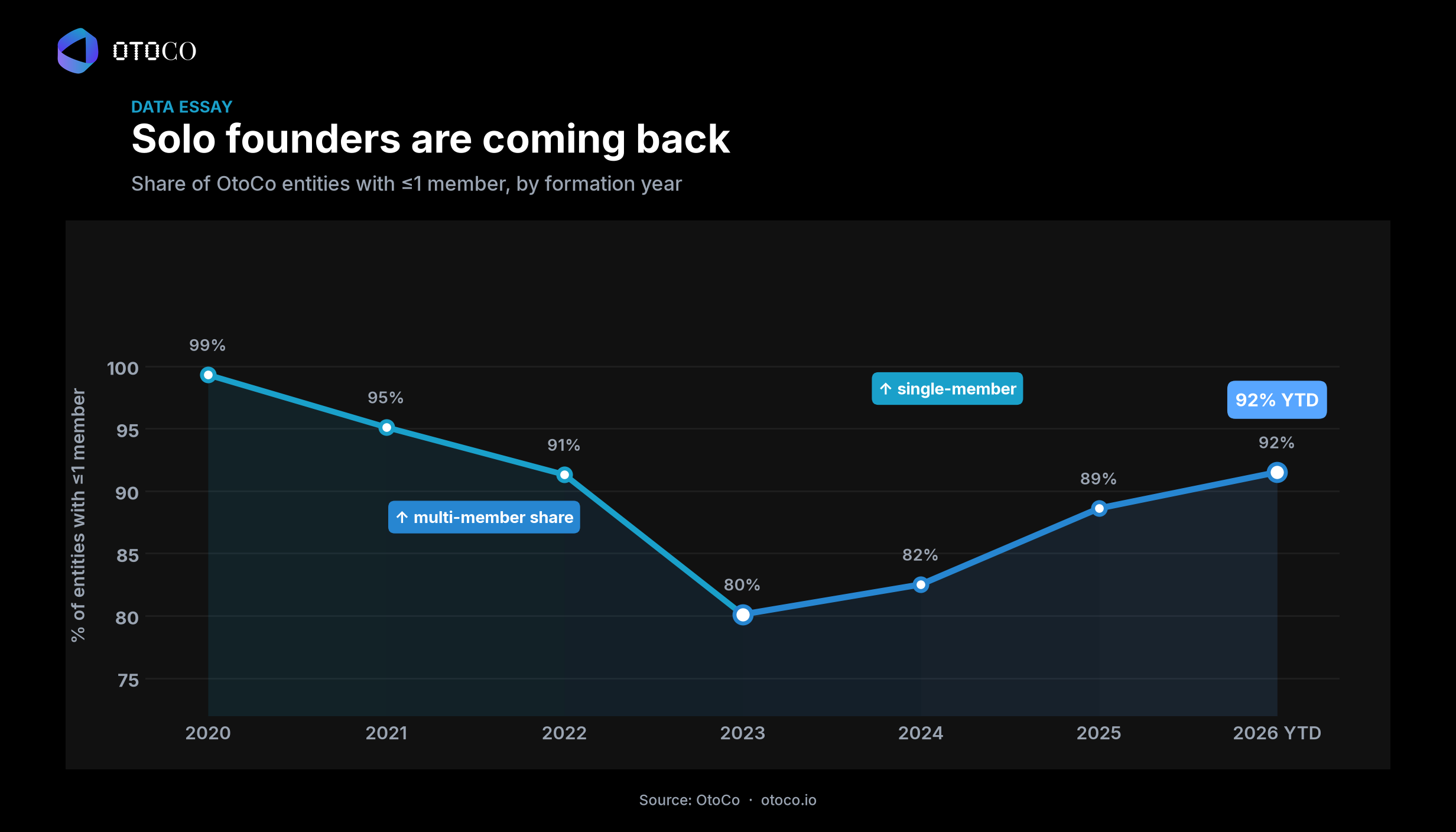
That solo path is not niche on OtoCo. Roughly ~88.7% of our book is single-member (≤1 member), and YTD 2026 formations sit near ~91.5% — the default onchain company is a solopreneur taking the wrapper seriously.
If a dispute appears — unpaid invoices that escalate, IP confusion, a contractor claim, a customer chargeback that turns legal — counterparties look for a person to chase. Without an LLC, that person is often you.
An LLC creates a liability shield: a legal boundary between company obligations and personal assets, provided you respect corporate formalities and do not treat the company as a costume. Think of it like shipping production traffic through a container. The container can fail without automatically sinking the whole host.
Is the shield absolute? No. Fraud, personal guarantees, and mixing personal/company funds can pierce it. But “not absolute” is not the same as “not worth having.” Seatbelts are not absolute either.
Banking and the EIN unlock
Serious business banking wants a company — not a freelancing hobby account that happens to receive wire transfers.
To open a proper US business bank account, you typically need:
- A formed LLC (legal name, formation date, state of organisation).
- An EIN — Employer Identification Number — the company’s US tax ID. Despite the word “Employer,” you do not need employees to need one.
- A coherent ownership story and operating agreement.
- A US business address in many onboarding flows.
Without the LLC + EIN pair, you stay stuck routing revenue through personal rails. That complicates taxes, confuses clients, and makes you look like an individual side project when you want to look like a vendor.
Non-US builders can get an EIN without an SSN — we wrote the step-by-step guide. And if you are opening accounts remotely, our US LLC bank account playbook for non-US founders covers the stack end to end.
Invoices, clients, and looking like a real vendor
Clients, marketplaces, and platforms increasingly ask for a business entity on vendor forms. A W-9, a company name on Stripe, a contract counterparty field — these are friction points for solopreneurs still billing as “Alex from Gmail.”
An LLC lets you:
- Invoice under the company name.
- Receive payments into a company account.
- Put the company on SaaS, ads, and contractor agreements.
- Separate brand reputation from personal identity when you want that boundary.
You can still be a one-person company. The outside world just gets a cleaner interface.
Taxes: pass-through without the jargon spiral
By default, many single-member LLCs are treated as disregarded entities for US federal income tax classification. Plain English: the IRS often looks through the LLC for income-tax purposes and taxes profits on the owner’s side — pass-through style treatment — rather than taxing the company first like a classic C-Corp.
That does not mean “no filings” and it does not mean “no bookkeeping.” It means the wrapper and the tax classification are related but not identical questions.
Foreign owners should especially note: pass-through / disregarded status can still come with US information reporting — including Form 5472 for many foreign-owned single-member LLCs. Filing required is not the same as tax owed. We cover that trap in our What Is Form 5472 and Why Foreign-Owned LLCs Must File It.
For bootstrapped builders keeping ownership and burn under control, a simple LLC is often the right first structure — then you graduate when investors, headcount, or complexity demand it. We wrote about why bootstrapped companies are rewriting the rules if that is your path.
What an LLC does not magically fix
An LLC is infrastructure, not a personality transplant.
It will not:
- Replace product-market fit.
- Make a vague business look bankable without a clear description.
- Erase personal guarantees you sign on purpose.
- Keep itself in good standing if you ignore renewals and registered-agent fees.
Treat the company like a production system: form it, fund it cleanly, keep records, renew on time. The shield works better when you respect the boundary.
The solo builder stack (minimum viable company)
If you want the practical checklist version, use this sequence:
Those four pieces map to what founders actually buy after formation on OtoCo — the same rails that keep a solo LLC bankable.
- Form the LLC in a state that matches your needs (Wyoming and Delaware are common OtoCo paths).
- Get an EIN — including the no-SSN route if you are foreign.
- Open a business bank account in the company’s name.
- Invoice and contract through the LLC going forward.
- Calendar compliance — state renewals, and federal information returns if they apply (including Form 5472 for many foreign owners).
For the data behind the solo default, see The Power of Building Without Outside Capital. For the full kit view — LLC + EIN + bank + tax as one checklist — see our Ultimate Solopreneur Company Kit. For crypto-native formation detail, our 2026 crypto LLC guide still maps cleanly onto many internet businesses.
FAQ: LLC for solo builders
Do I need an LLC if I am just freelancing?
Not always legally required — but once revenue, contracts, or client risk become real, operating forever in your personal name is usually the riskier default.
Can a single person own an LLC?
Yes. A single-member LLC is a standard structure for solopreneurs.
Is an LLC only for US residents?
No. Non-US founders can own US LLCs. Banking and EIN steps have extra paperwork, but the path is well travelled.
Does forming an LLC mean I owe US income tax?
Not automatically. Tax owed depends on your facts. Filing and reporting obligations can still exist even when US income tax is low or zero — especially for foreign owners.
Form the wrapper. Keep building.
Every builder eventually needs a place for contracts, cash, and liability that is not their personal name. An LLC is that place. You do not need a board, a seed round, or permission from the old world to start one.
That is what we built OtoCo for: bringing serious company infrastructure within everybody’s reach — whilst you stay focused on the work only you can do.
Form your company at otoco.io — then get back to building.
Disclaimer: This article is general information, not legal, tax, or accounting advice. OtoCo is not a law firm or CPA firm. Entity and tax rules depend on your facts and can change. Consult qualified advisors for your situation.